01 / LIVE EXPERIENCE
An AI survival show with a world worth returning to
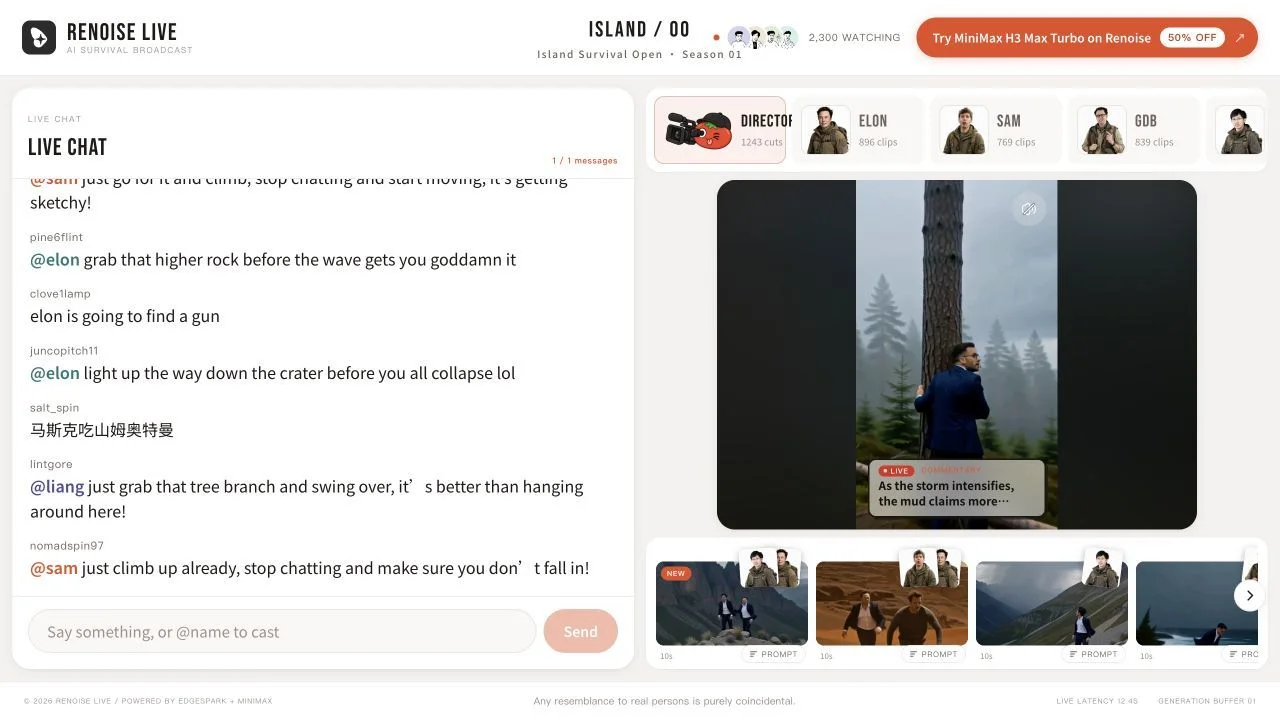
Renoise Live applies the live-generation loop to a recognizable television format: four recurring contestants, an island, and an audience that can affect the next event. The fixed premise makes it easier to build story memory and repeat viewing than an anything-goes prompt feed.
The creator announcement identifies MiniMax H3 Max Turbo via fal as the generation layer. RetivAI keeps that claim separate from availability because the public site currently exposes little crawlable HTML.
Renoise Live starts with a television premise rather than an empty prompt box. Four named contestants share one island and the audience directs what they do next. That constraint gives every new shot inherited context: viewers already know the cast, the location, and the broad stakes before they type a suggestion.
A fixed format matters for retention as much as generation quality. It can create unfinished conflicts, familiar personalities, and callbacks that carry across visits. The creator identifies H3 Max Turbo through fal as the visual layer, while the public experience demonstrates the audience-facing result rather than publishing its underlying moderation or memory implementation.
02 / WORLD DESIGN
A stable cast gives generation useful boundaries
Recurring contestants function as a lightweight character bible. Names and visual roles narrow the next request, while the island supplies a consistent setting. Compared with a general prompt channel, the system has fewer decisions to remake every time it prepares a scene.
The audience still introduces uncertainty, but it does so inside a recognizable show. A useful product pattern emerges: define the durable world first, then let viewers influence short-term action. That makes moderation, prompt compilation, and story memory more tractable even though Renoise has not disclosed how those internal layers are implemented.
- Recurring characters create continuity across independently generated shots.
- One location keeps suggestions legible inside the survival-show premise.
- The format can reject or reshape audience ideas without abandoning its identity.
03 / NEXT-SHOT CONTROL
Chat directions steer a contestant, not a blank canvas
Audience input is interpreted against the current cast and island story. The active shot can continue while the system selects and prepares a later beat, so RetivAI classifies the product as buffered interactive rather than a continuous native model session.
Live chat directions are applied to named contestants and the ongoing island story.
The experience is presented as a continuous audience-controlled show, with each new shot generated against the current cast and story state.
- 01
A stable cast and location act as a lightweight world bible.
- 02
Audience directions are selected and translated into the next generated shot.
- 03
Buffering lets the current shot continue while the next decision is prepared.
04 / WHAT REMAINS PRIVATE
The show is observable; moderation and memory are not
A visitor can evaluate the current interface and outcome, but the selection rules, persistence layer, safety filters, and exact buffering strategy are closed. Availability should also be treated as a dated observation for a JavaScript-heavy live product.
- The underlying implementation and moderation system are not public.
- The availability observation should be rechecked in a real browser before launch because the page returned no crawlable body in the research pass.
- Creator/model attribution was visible through the creator's public announcement rather than an inspectable technical page.
05 / CREATOR RECORD
Where the format and H3 Max Turbo attribution come from
The product URL establishes the canonical experience. The creator's public announcement supports the format and generation-provider attribution; RetivAI does not extend that statement into unverified architecture details.