01 / OPEN-SOURCE PROJECT
A streaming-service shell around just-in-time episodes
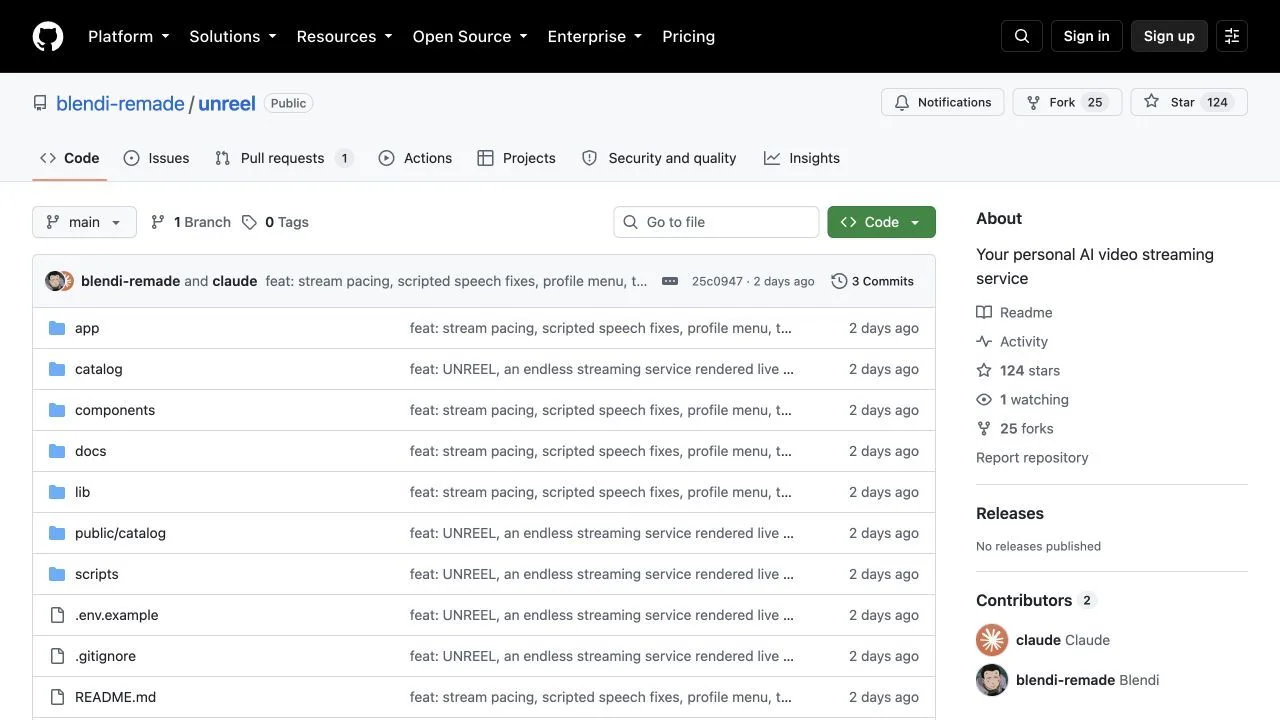
UNREEL packages just-in-time generation like a streaming service. A pre-rendered cold open starts immediately; meanwhile, a showrunner plans upcoming shots and H3 Max Turbo renders them from the last frame of the current stream.
Its story titles use a continuous image-to-video chain, while chaos channels hard-cut between gags. The repository explains how the buffer, same-origin media proxy, quoted dialogue, and fallback hold frame work together.
UNREEL begins with a familiar catalog, but selecting a title starts a production system rather than retrieving a finished episode. A pre-rendered cold open plays immediately while a showrunner writes upcoming shots and H3 Max Turbo generates them in the background.
Story titles pass the final image of one shot into the next image-to-video request, while chaos channels can use hard cuts between independent gags. A browser-owned state machine manages both patterns, which makes the project particularly useful for understanding what sits around a fast model: planning, media proxying, buffering, playback, and recovery.
02 / PLAYBACK ILLUSION
The cold open buys time for the first live shot
The hardest gap in just-in-time television happens immediately after a viewer presses play. UNREEL covers it with an existing opening segment, allowing generation to begin behind content that is already watchable. Later, the last displayed frame can remain on screen briefly if the next video misses its handoff.
These techniques do not make generation instantaneous. They allocate latency to places the viewer is more likely to tolerate it. The result depends on a producer-like showrunner that plans concise upcoming actions early enough for the renderer, rather than trying to generate an entire long episode before playback.
The catalog also separates editorial identity from runtime generation. A title, thumbnail, and cold open can be prepared and quality-controlled once, while the variable continuation begins only after a viewer commits to watching. That keeps discovery fast without pretending the generated episode already exists.
- Cold open handles initial startup latency.
- Last-frame image capture supports visual continuity between story shots.
- Hold frames and a small queue absorb variation in render completion time.
03 / SHOWRUNNER LOOP
Upcoming shots are written while the current one plays
A viewer chooses the premise once, then the showrunner continually supplies the next bounded scene. Generation and playback overlap, with the queue acting as the contract between narrative planning and the video player.
A viewer selects a title; the showrunner generates an open-ended episode while playback continues.
Upcoming shots are generated while the current shot plays. The first frame handoff creates continuity, and a small buffer absorbs generation variance.
- 01
A cold open removes the initial blank wait while the first live shot is prepared.
- 02
Image-to-video shots chain from the browser-captured final frame of the prior clip.
- 03
A client state machine owns the shot queue, render buffer, and handoffs.
- 04
The player holds the last frame briefly if the next shot misses its deadline.
04 / RUNNING COST
An endless interface still consumes paid generations
The project is a source prototype, not an asserted public service. Its creator-reported timings and costs are useful operational notes but are not RetivAI benchmarks, and the inspected repository did not present a clear reuse license.
- The repository did not expose a clear license during review, so RetivAI does not copy its code or catalog assets.
- Generation-rate and cost measurements in the README are creator observations, not RetivAI benchmarks.
- A continuous session incurs ongoing provider cost for as long as the viewer watches.
05 / IMPLEMENTATION RECORD
The README connects story planning to the media buffer
The repository supports the showrunner, model, queue, continuity, proxy, fallback, and access claims used in this profile. RetivAI does not copy the project's catalog assets.