01 / OPEN-SOURCE PROJECT
When the generated frame becomes game state
LAST FRAME treats generated video as the authority: if a risky move produces a bad outcome on screen, that outcome becomes the state of the game. A vision adjudicator reads landed shots and updates vitality, inventory, completed facts, victory, and death.
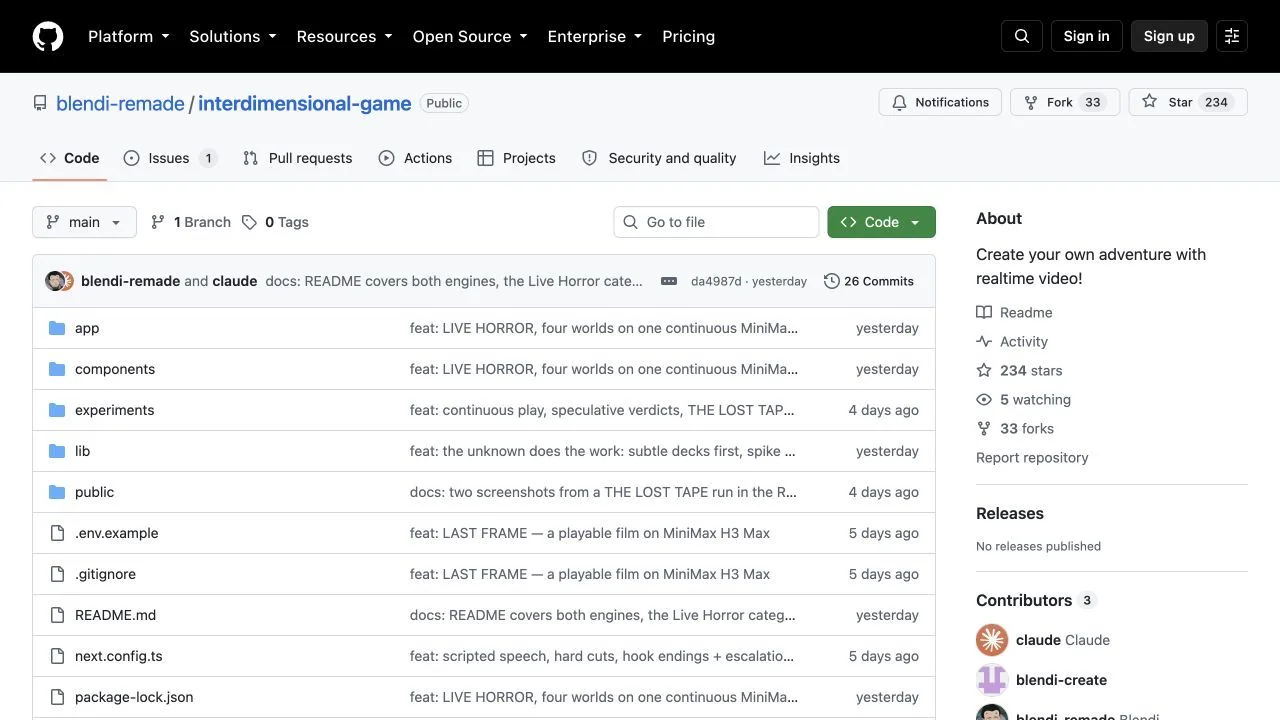
The repository contains two distinct engines. Its shot engine prefilms three possible ten-second branches while the current clip plays. Its live horror engine holds one continuous Director WebRTC session and applies player choices at upcoming chunk boundaries.
LAST FRAME treats the visible outcome as authoritative. A player can choose a suggested move or type a risky action, but the application does not simply declare success in text. It generates the consequence, asks a vision step to inspect what landed on screen, and carries that observation into vitality, inventory, completed facts, victory, or death.
The repository contains two meaningfully different engines. One prepares three possible ten-second branches while the current shot plays. The other keeps a Director WebRTC session running and applies player choices near later chunk boundaries. Both reduce waiting, but only the second is a native continuous generation session.
02 / GAME LOGIC
The referee reads the movie instead of overruling it
A conventional game engine calculates state first and renders a faithful view afterward. LAST FRAME reverses part of that relationship. The image-to-video model can introduce an unexpected detail, and the adjudicator extracts evidence from the landed shot so later choices remain consistent with what the player actually saw.
Typed risky actions add another visible rule. A referee and roll decide which outcome prompt should be generated, while evidence stills give the state update something concrete to cite. This is an important product pattern for probabilistic media: make uncertainty legible and record the artifact used to update state.
- Shot mode pays for unused branches in exchange for immediate choices.
- Director mode accepts compact steering inside one continuous horror stream.
- The last frame anchors continuity when the system starts a new generated shot.
03 / TWO REALTIME ENGINES
Parallel branches hide latency; Director removes the restart
The shot engine renders future options before a player chooses, while the live engine holds one WebRTC session and applies input roughly at chunk boundaries. They create a similar player experience with different cost and continuity characteristics.
Players choose one of three moves or type their own; live horror worlds accept moves during a continuous stream.
Director mode keeps one WebRTC stream moving and sends a new prompt around every nine seconds or after a player move. Shot mode hides generation behind the current clip by rendering branches in parallel.
- 01
The last frame of a shot anchors the next image-to-video branch.
- 02
A vision adjudicator converts visible outcomes into game state and evidence stills.
- 03
Typed risky actions use a referee and visible roll before selecting success or failure generation.
- 04
Live horror draws from constrained event decks and sends compact steering prompts to Director.
04 / COST AND RIGHTS
Unused branches still cost money, and the code license is unclear
Parallel prediction can multiply provider spend because two losing branches are discarded. The inspected repository also did not expose a clear license, so this profile analyzes and links the work without redistributing its code or media.
- The repository did not expose a clear license during review, so RetivAI links and analyzes it without copying code or media.
- Parallel branch generation can multiply provider spend because unused branches still render.
- The project's own cost note describes paid generation; users should set strict provider limits.
05 / CODE AS EVIDENCE
The repository documents both engines and their state contract
Implementation claims come from the source project. fal's API reference is used only to corroborate the Director session behavior, not to endorse the game or its economics.