01 / OPEN-SOURCE PROJECT
The conversation stays live while the visual track catches up
H3 Max Realtime Education separates conversational immediacy from video generation. Voice interaction continues while a visual director turns concrete science subjects into safe, five-second teaching clips.
When a learner interrupts, stale generation is cancelled without blanking the current video. The first decoded clip for the new topic replaces the old visual track, making the system responsive even though each visual is still a discrete generation.
H3 Max Realtime Education does not require generated video to match the speed of speech. Voice remains the immediate interaction channel, while a visual director extracts concrete scientific subjects and prepares short teaching clips that support the newest useful explanation.
That separation gives interruption a clear meaning. When a learner changes direction, pending work for the old topic is invalidated, but the currently decoded video remains visible. The first ready clip for the new topic performs the visual handoff, avoiding a blank player while still respecting the learner's latest intent.
02 / INTERRUPTION SEMANTICS
Cancel stale work without erasing what the learner sees
Video jobs are tagged to the active subject so an interruption can make older queued clips ineligible for playback. Cancellation is therefore a product rule, not only an infrastructure optimization: it prevents a technically successful generation from teaching the wrong concept after the conversation has moved on.
The prompt compiler is deterministic around style, duration, composition, and safety constraints. The language model can choose the educational subject, but the application retains control over how every short visual should be framed. Per-learner and global quotas add a second boundary around paid generation.
The audio and video tracks therefore have different freshness requirements. Speech must acknowledge the learner immediately, while an illustration can arrive a few seconds later if it is still accurate and clearly supportive. Designing those tolerances separately avoids forcing every modality into the slowest part of the system.
- Realtime transcript fragments are reduced to concrete teachable subjects.
- Five-second clips keep the queue bounded and replacement points frequent.
- The current decoded clip remains as a bridge until the new topic is ready.
03 / VOICE-LED LOOP
Barge-in updates the queue before it updates the screen
Speech and interruption carry the immediate exchange. The visual pipeline then cancels stale jobs, compiles a safe scene prompt, and swaps tracks only after the replacement has decoded.
A learner talks to the tutor and can interrupt; the visual queue follows the newest useful science topic.
Realtime voice and barge-in drive a bounded queue of five-second clips. The current decoded video stays visible until a new-topic clip is ready.
- 01
Realtime transcript fragments are reduced to concrete scientific subjects.
- 02
A deterministic compiler adds a stable illustrated style, duration, safety, and layout constraints.
- 03
Interruptions invalidate stale queued work while playback continues.
- 04
Per-learner and global quotas bound generation spend.
04 / PRODUCTION READINESS
The local demo is not a finished education platform
Public use needs the durable storage, encryption, rate limiting, origin controls, and transcript protections described by the repository. Generated explanations also require curriculum and safety review beyond the software's technical guardrails.
- This is an educational prototype, not an authoritative curriculum or safety adviser.
- Public deployment requires additional database, Redis, encryption, origin, and rate-limit controls described by the project.
- Voice and generated-video prompts are sent to configured external providers.
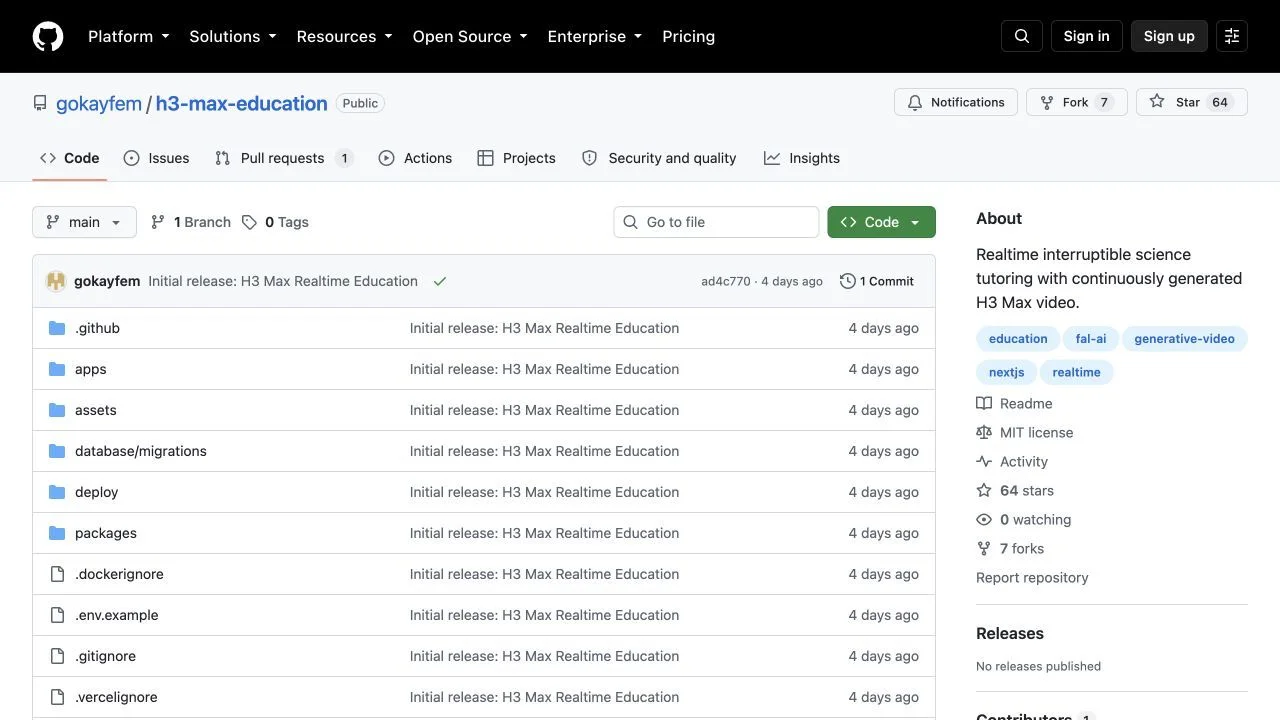
05 / SOURCE REVIEW
The code defines queue invalidation, quotas, and deployment gaps
All detailed claims on this page are bounded to the inspected repository. It establishes an MIT-licensed prototype and does not establish educational authority or production certification.