01 / VIDEO INFRASTRUCTURE
A control plane for keeping generated clips on air
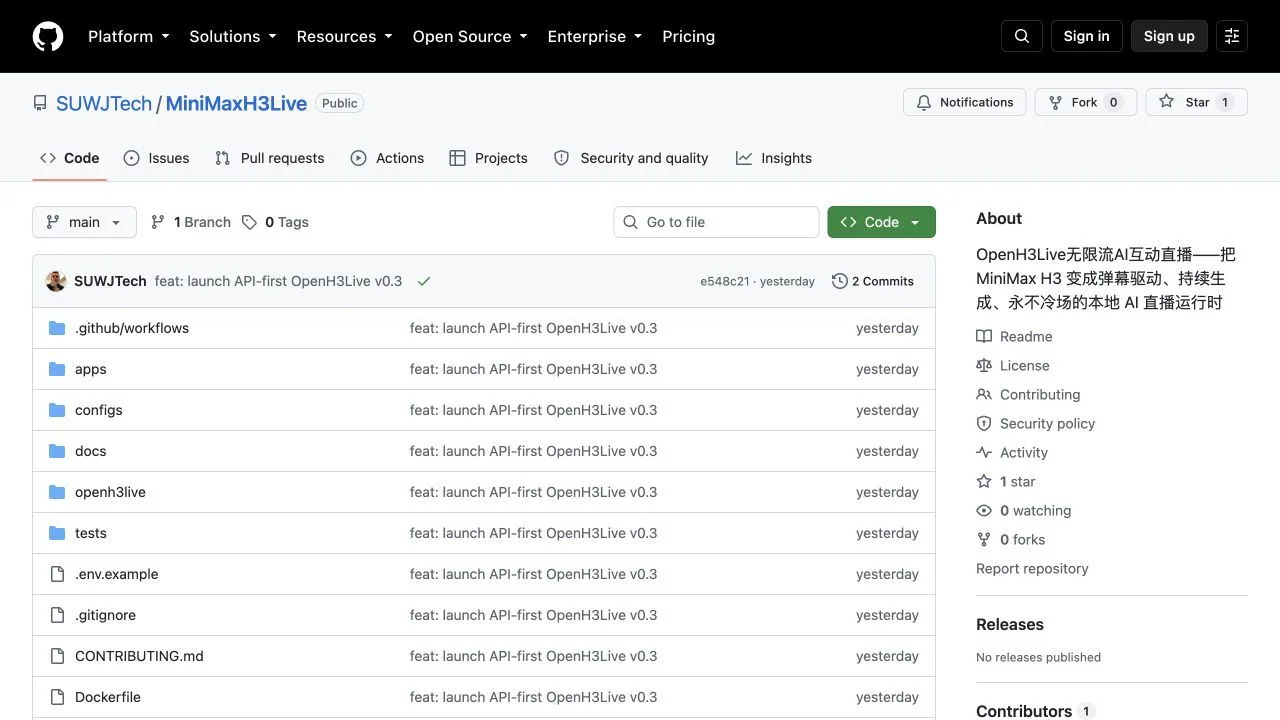
OpenH3Live is a practical reference for the buffered-interactive branch of the category. It ingests audience messages, scores and moderates them, turns selected ideas into scene specifications, generates clips, and keeps a continuous player or RTMP output supplied.
Its current provider path uses the MiniMax H3 cloud API, with a real H.264/AAC mock mode for free local development. The project clearly labels fal H3 Max Director as planned or experimental rather than current functionality.
OpenH3Live focuses on orchestration rather than one entertainment format. It accepts audience messages, removes duplicates and spam, ranks usable ideas, maintains story memory, compiles a structured scene request, and feeds finished clips into preview or RTMP playout.
The current cloud path uses MiniMax H3 clip generation. A mock provider creates valid H.264 and AAC media without an API key so developers can exercise queueing, player transitions, failure handling, and operator controls before spending money. H3 Max Director appears only as a planned or experimental route and is not presented here as implemented functionality.
02 / CONTROL PLANE
The state machine makes latency an operating condition
IDLE, PREBUFFER, LIVE, and STOPPING states give the operator and player a shared account of what the channel is doing. Before going live, the system fills a target runway. During playout, a clip ledger and checkpoints record what is queued, available, consumed, or recoverable.
Filler is an explicit safety valve rather than an accidental replay. When generation fails or falls behind, a known-safe clip can preserve the outgoing stream while the control plane retries or advances. That is less visually seamless than native realtime, but it makes failure behavior testable and keeps one provider timeout from necessarily ending a broadcast.
Mock mode makes that reliability work testable without disguising synthetic output as a successful cloud render. Teams can validate media compatibility, queue transitions, operator actions, and restart behavior first, then enable paid generation only after the surrounding control plane is stable.
- Chat moderation and priority happen before a request reaches generation.
- Story memory is compiled into a SceneSpec instead of passed through as raw chat.
- A configurable cloud-generation cap limits a session's paid work.
03 / BUFFERED PIPELINE
Audience ideas become scenes only after moderation and scheduling
Selected messages enter a structured production queue. The control plane aims to keep enough decoded clips ready for preview or RTMP while filler and checkpoints protect the output from slow or failed generations.
Audience chat becomes prioritized scene requests while an operator watches the queue and stream state.
A state machine prebuffers a target number of clips and inserts safe filler on generation failure, allowing a continuous preview or RTMP output even when generation is slower than playback.
- 01
An IDLE → PREBUFFER → LIVE → STOPPING state machine governs playout.
- 02
Chat deduplication, spam checks, priority, and story memory feed a SceneSpec.
- 03
A clip ledger, checkpoints, and filler support crash and provider recovery.
- 04
A configurable generation cap defaults to twenty cloud clips per session.
04 / PROVIDER AND PLATFORM
Infinite scheduling does not mean unlimited generation
The loop can continue, but cloud clips consume quota and the default cap is finite. Public streaming also needs platform credentials, platform-specific moderation, and operator policies that are outside the core repository.
- Current production generation is MiniMax H3 clip generation, not H3 Max Director.
- The word infinite describes the scheduling loop, not unlimited free API use.
- Operators still need platform-specific authentication, moderation, and policy checks before public streaming.
05 / SOURCE-DEFINED CONTRACT
The repository documents providers, recovery, and roadmap status
Source and documentation establish the current MiniMax H3 path, mock mode, state machine, controls, license, and future Director boundary used in this profile.