01 / LIVE EXPERIENCE
One canonical profile for a viewing site and its open reference stack
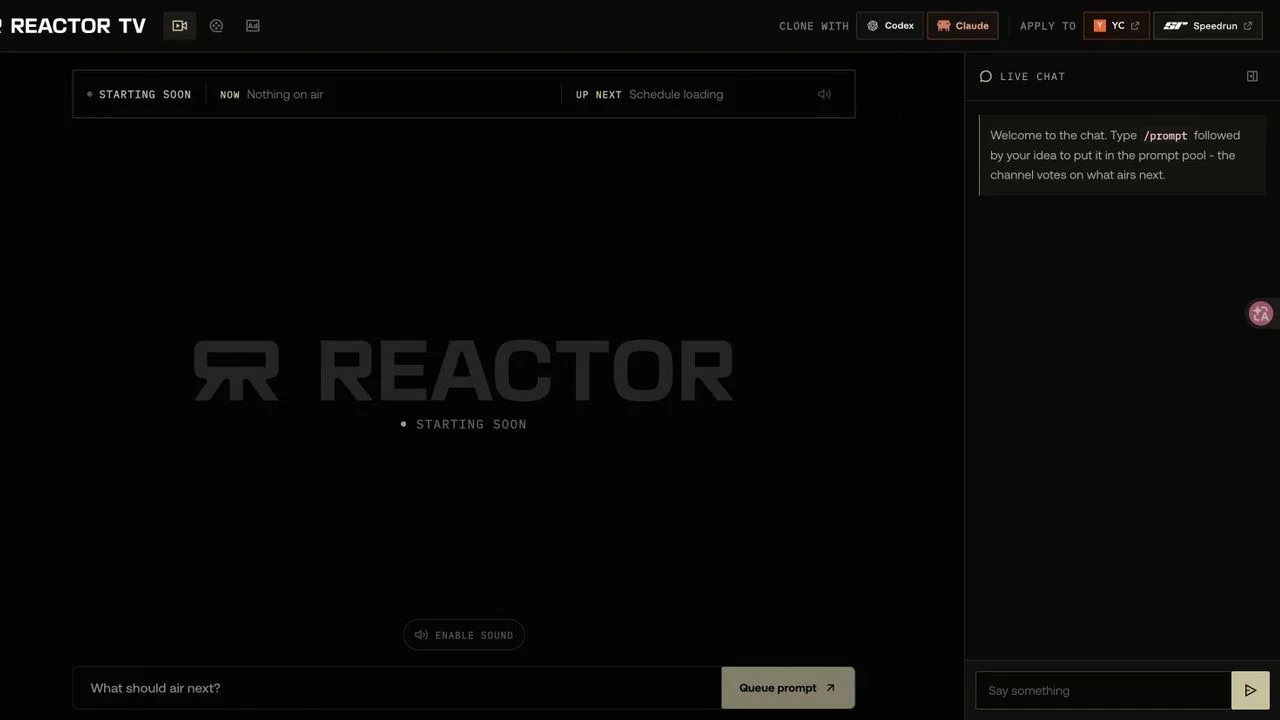
Reactor TV is a public viewing surface with named shows, episode cards, recent replay timestamps, and a distinct on-air state. It was reachable during review but displayed Nothing on air, so RetivAI records a live public service without claiming that a broadcast was active at that moment.
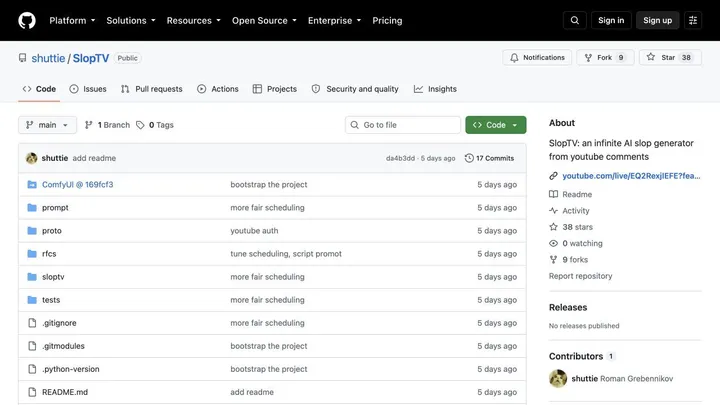
The linked Infinite Livestream repository divides an open reference implementation into a FastH3 model service and a streaming client that converts Twitch or YouTube prompts into paced RTMP output. The repository does not establish the exact production model behind live.reactor.inc, so its FastH3 identity is attached to the inspectable reference stack rather than asserted as a hosted-service fact.
Reactor TV now has a public product surface at live.reactor.inc. The reviewed page organized generated programming into named shows and episode cards, with recent replay timestamps and a separate on-air area. The service was reachable, yet its status read Nothing on air at the check moment. That combination supports a live product classification without pretending a broadcast was actively playing.
The linked Infinite Livestream repository adds a second, inspectable layer. It documents how a streaming client can listen to Twitch or YouTube, turn accepted commands into styled scene groups, queue them with a served FastH3 model, and pace returned media into RTMP. RetivAI keeps the two evidence scopes explicit: the website proves the public catalog, while the repository proves one open reference architecture. It does not prove that the production website currently runs the same model or deployment.
02 / PRODUCT AND REPLAY LAYER
Recent episodes remain useful when nothing is on air
A generated channel does not have to discard its value when a live session ends. Reactor TV exposes show identities and individual episodes as a replay catalog, giving a visitor something concrete to browse while the on-air slot is empty. Recent relative timestamps observed during review indicated that the catalog was being updated even though there was no active program at that instant.
This is an important availability distinction. RetivAI uses Live for the reachable, maintained public service and records the off-air observation as a limitation. It does not convert a transient status message into Offline, and it does not treat one successful HTTP response as proof that generation or playback is continuously operating behind the page.
- The public site and source repository share one profile to avoid duplicate entities.
- Show, episode, replay, and on-air states describe the audience-facing layer.
- The exact production model remains undisclosed in the reviewed public interface.
03 / OPEN REFERENCE PIPELINE
The repository turns chat commands into paced RTMP programming
In the open implementation, the model side owns queued execution and a typed playback contract. The client owns chat adapters, command syntax, prompt upsampling, scene grouping, moderation, filler, pacing, and the outgoing RTMP sink. WebRTC moves synchronized model output to that client before it becomes a shared broadcast.
The public site lets viewers browse current or recent AI shows; the open reference client additionally accepts Twitch or YouTube `!prompt` commands for a shared broadcast queue.
The client keeps a model-side generation queue feeding paced RTMP output, while WebRTC transports media tracks between the served model and the streaming client.
- 01
The hosted site organizes generated programming into named shows, recent episodes, replays, and a separate on-air state.
- 02
The open streaming client owns chat sources, prompt upsampling, scenes, moderation, filler, and RTMP sinks.
- 03
The FastH3 service exposes explicit queue and playback messages over a typed wire contract.
- 04
The generated stream includes synchronized audio and 768p clips according to the repository.
04 / MODEL AND UPTIME BOUNDARIES
FastH3 is verified for the code, not silently assigned to production
The repository and model card identify FastH3 Preview v1 as a four-step MiniMax H3 derivative and describe a substantial multi-B200 target. That is strong evidence for the open stack, not for the hosted site's current backend. Operators also need runtime access, ffmpeg, destination credentials, moderation, and separate code and model-license review.
- The public service did not identify its exact production model in the reviewed interface. FastH3 is confirmed only for the linked open reference implementation and should not be confused with H3 Max.
- The site showed no active on-air program at the review moment even though recent replay cards were present.
- The documented model service targets eight B200 GPUs, placing it outside most hobbyist local setups.
- Code and model weights have separate licenses.
05 / THREE-LAYER EVIDENCE CHECK
Website, repository, and model card support different claims
The official product supports catalog and dated availability observations. The Apache-licensed repository supports the client-service architecture. The model card supports FastH3 identity and model-term boundaries. Keeping those sources separate prevents both an inaccurate H3 Max attribution and an unsupported claim about the hosted backend.