01 / LIVE EXPERIENCE
The next shot is planned from everything the program has already shown
Artificial TV frames itself as a television stream that writes the next scene while it runs. A viewer can provide a premise, then watch a director use the program history to plan another shot while several camera views are generated in parallel.
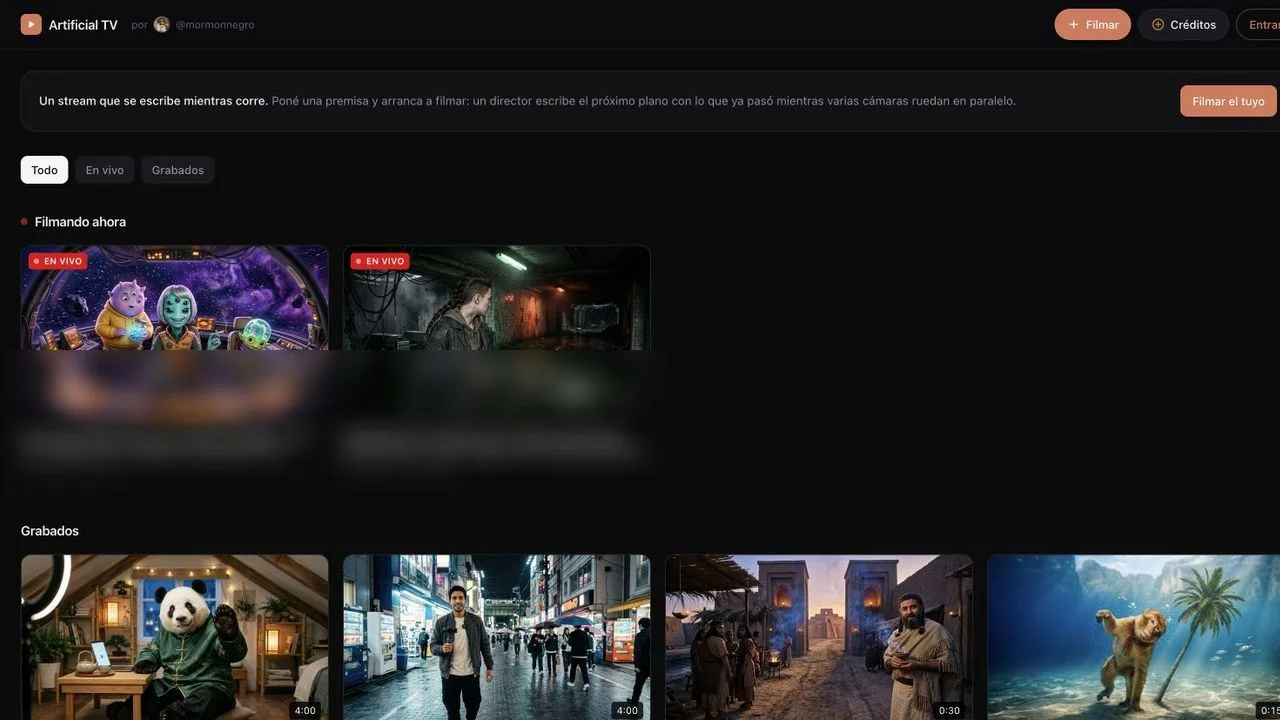
The public interface exposes live, recorded, and generating states, making the production loop visible. The reviewed pages do not identify the exact video model, so RetivAI includes the product in the broader category while recording its technology as Other rather than guessing H3 or H3 Max.
Artificial TV describes its central illusion directly: the stream writes itself while it is running. A visitor provides a premise, and a director component uses the accumulated program history to decide what should appear next. Several camera candidates are then generated in parallel, turning selection and sequencing into part of the television system.
The reviewed Spanish-language interface exposed live, recorded, and generating states. Those states support a just-in-time classification because upcoming material is prepared around an existing program rather than delivered through a verified continuous model session. The site did not publicly name its generation model, so RetivAI uses Other for technology. Category relevance does not justify filling that evidence gap with an H3 or H3 Max guess.
02 / DIRECTOR AND CAMERA MODEL
Parallel camera candidates make editorial selection part of generation
A single generated clip pipeline asks the model for one answer and accepts whatever arrives. Artificial TV's public explanation points to a more editorial pattern: the director defines the next shot from program history while multiple camera views are prepared in parallel. The product can then choose among visual candidates before extending the program, much like a control room selecting an angle.
History gives the director more than the latest prompt. It can preserve the premise, remember recent events, and avoid treating every segment as an unrelated text-to-video request. The reviewed interface does not reveal the size of that memory or the selection algorithm, so continuity remains a product intention rather than a measured RetivAI result.
Recorded programming supplies a second surface alongside live and generating states. Replays can make an otherwise temporary session discoverable, provide something to watch between active broadcasts, and create evidence of the format without requiring a viewer to arrive at the exact live moment. That separation is especially useful for a small experimental network with variable generation capacity.
- Spanish is the product's primary public language at the reviewed URL.
- A viewer premise seeds the program rather than controlling every camera directly.
- No exact video model or provider is assigned without first-party evidence.
03 / PREMISE-TO-CAMERA LOOP
The audience sets the show; the director chooses the upcoming shot
The visitor establishes what the program should be about. From there, the service consults prior program context, plans another beat, generates camera candidates, and advances the shared viewing experience. Interaction is format-level direction, not verified frame-by-frame steering.
A visitor supplies the program premise and watches the service plan and generate subsequent shots for a shared television-style experience.
The current material remains the viewing surface while a director uses prior program context to prepare the next shot and parallel camera candidates. It is a buffered clip workflow rather than verified native streaming generation.
- 01
A viewer-written premise establishes the program that the system should continue.
- 02
A director component references prior program history when deciding what the next shot should contain.
- 03
Multiple camera candidates are generated in parallel before one becomes part of the program flow.
- 04
Recorded material provides a replay surface when no program is actively on air.
04 / UNKNOWN MODEL, PRIVATE STACK
Visible production states do not reveal the underlying engine
The official interface supports the premise, history, camera, and playback observations but does not identify the exact generation model. The closed stack also leaves moderation, camera selection, storage, retries, and operating cost unverified. Viewer-written sensitive prompts are not reproduced in this profile.
- The exact generation model is not publicly identified in the reviewed interface, so no H3-family attribution is made.
- The product is closed source; scheduling, camera selection, moderation, storage, and failure recovery cannot be independently inspected.
- Public premises can contain adult or otherwise sensitive material. RetivAI summarizes only the neutral product mechanics and does not reproduce viewer prompts.
05 / FIRST-PARTY INTERFACE REVIEW
Classification stops where the product's own disclosure stops
Artificial TV itself is the source for the public workflow and dated state observations. With no inspectable repository or attributable model statement, RetivAI records strong product evidence and an intentionally unresolved technology field.