01 / LIVE EXPERIENCE
A generation request packaged like a streaming-service title
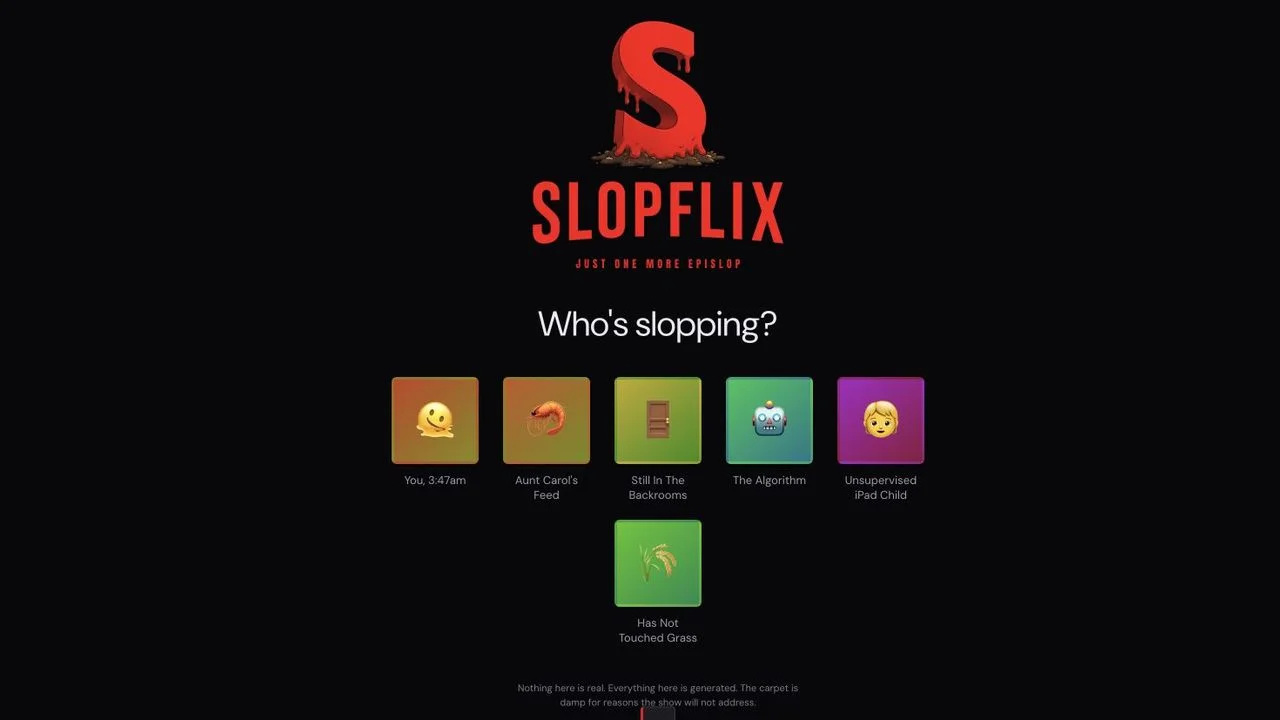
Slopflix presents generation through the familiar language of streaming television. Visitors can browse completed titles, open a watch page, or start a new movie or series from a premise instead of working through a model playground.
The shipped browser code identifies MiniMax H3 Max and exposes separate generation and job-status requests. That supports a just-in-time workflow in which a requested program is assembled asynchronously, but RetivAI did not spend provider credits or trigger a new generation during review.
Slopflix hides most model vocabulary behind a familiar entertainment interface. A visitor first sees cover art and completed programs, can open a watch page, and may then start a movie or episodic series from a premise. That order matters: the catalog explains the product before the creation form asks anyone to spend time on generation.
The inspected browser application identifies MiniMax H3 Max and separates creation from job polling. RetivAI therefore classifies the experience as just-in-time generation, not native realtime. A request begins an asynchronous production process whose result later becomes watchable media. We reviewed the public interface and shipped client behavior, but deliberately did not press the generation control, consume provider capacity, or claim a measured turnaround time.
02 / CATALOG PRODUCT DESIGN
Finished programs give the queue somewhere durable to land
A one-off generator ends at a downloadable file. Slopflix instead gives an output a title, artwork, format, and watch destination, so generated media can participate in discovery after the initial request finishes. Movies promise a bounded viewing object; series imply a return loop in which a premise can support more than one installment. Those are product decisions around H3 Max rather than model capabilities by themselves.
The catalog also absorbs latency. A visitor can inspect existing titles while another program is being prepared, and the job interface can report progress without pretending that the video is already live. This makes the service a useful example of asynchronous generation feeling like television even though it does not preserve one continuous WebRTC session.
Slopflix's public surface also contains material unrelated to watching or generating programs, including a promoted token contract. RetivAI excludes that from the feature assessment. Its presence neither verifies the video pipeline nor receives an endorsement here; users should evaluate any financial claim independently and with appropriate caution.
- Browse and watch surfaces exist independently of the new-generation form.
- Movie and series choices create different expectations for completion and continuity.
- Public client requests expose generation and job-status stages without revealing the private orchestration service.
03 / PREMISE-TO-PROGRAM LOOP
The viewer commissions a title rather than steering every shot
The primary control is a premise and a format choice. Once submitted, the request moves into a background job and the browser checks its state until media can join the catalog. The creative relationship is therefore closer to commissioning an on-demand program than directing a scene beat by beat.
A viewer supplies a premise and chooses a movie or episodic format, then waits for the resulting program to join the viewing catalog.
The public application submits a generation request and polls a job endpoint while a program is being prepared. It is an asynchronous on-demand loop, not one continuously steerable WebRTC session.
- 01
A streaming-style catalog makes completed AI programs discoverable before a visitor creates anything.
- 02
The creation form collects a premise and program format, then hands the request to an asynchronous generation job.
- 03
The browser polls job state until media is ready rather than holding a native Director session open.
- 04
Completed output moves into a title-and-watch experience designed for episodic return visits.
04 / UNTESTED GENERATION BOUNDARY
Interface evidence cannot substitute for a completed fresh episode
RetivAI did not initiate a generation, measure queue time, audit a new title for continuity, or inspect provider billing. The closed implementation also leaves moderation, retention, retries, and cost ceilings unresolved. This page documents what the public product exposes, not a hands-on quality benchmark.
- RetivAI did not submit a generation, measure completion time, or verify the quality and continuity of a newly produced title.
- The implementation is closed source, so orchestration, moderation, retention, and provider-cost controls are not independently inspectable.
- The site includes a separate token promotion. RetivAI does not evaluate or endorse that financial material as part of this product profile.
05 / PRODUCT AND CREATOR RECORD
The site supports the workflow; the official account supports the launch identity
The live product supports the catalog, creation choices, browser-visible H3 Max references, and asynchronous job states. The official account provides a separate first-party H3 Max launch statement. Neither source proves unpublished infrastructure or permanent availability.