01 / LIVE EXPERIENCE
The prompt queue is part of the show
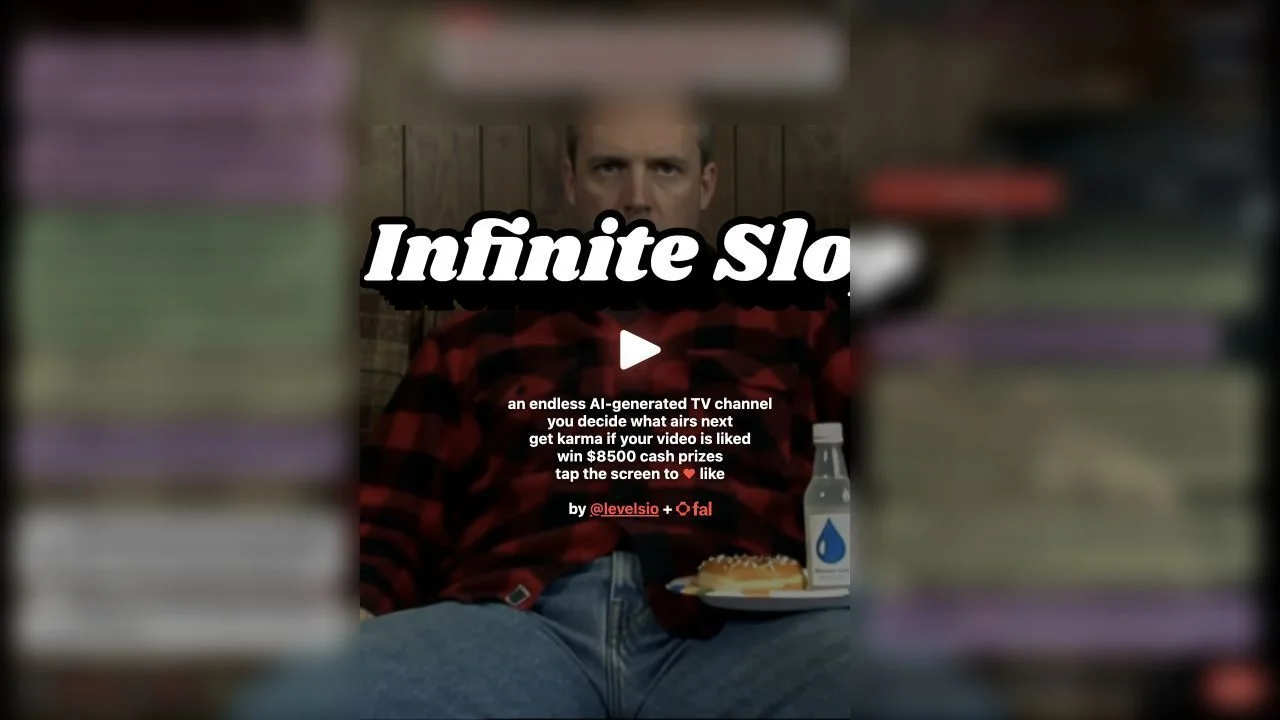
Infinite Slop turns a public prompt queue into programming. The live interface shows chat, queue, ranking, generation, and on-air states, so the audience can see the production loop rather than only the final clip.
The format is deliberately open-ended: categories such as news, game show, space, and cats coexist inside one continuous channel. That makes it a useful example of community programming, but a weaker fit for long-term character continuity than a fixed show format.
Infinite Slop exposes production state instead of hiding it. Viewers can see ideas move through a shared queue, observe what is generating, watch the selected output go on air, and react to the result. The waiting room becomes programming because everyone is looking at the same pipeline.
That makes the experience more participatory than a playlist of AI clips, even though each segment is still generated just in time. RetivAI can verify the interaction and broadcast design on the public product. The H3 Max label is kept at a lower evidence level because it comes from reporting about the builder rather than a technical statement on the product page itself.
02 / AUDIENCE PROGRAMMING
Ideas compete for the next slot on air
A visitor proposes a scene inside a common channel rather than opening a private job. Queue position, visible generation, likes, and ranking provide feedback before and after the clip airs, turning selection into a collective programming mechanic.
Viewers submit what they want to see next, join a visible queue, and like or rank results.
The public interface separates NOW GENERATING, QUEUE, and ON AIR states, showing that new material is produced while the channel continues to play.
- 01
A viewer prompt enters a visible queue instead of starting a private generation job.
- 02
Finished outputs become the shared broadcast rather than a personal download.
- 03
Likes and ranking add feedback to the programming loop.
03 / FORMAT TRADEOFF
An anything-goes channel optimizes for surprise
News parodies, game-show concepts, space scenes, animals, and other categories can appear in the same stream. That range lowers the barrier to participation because almost any idea can fit. It also gives the system a renewable source of short, self-contained beats when a previous prompt has ended.
The tradeoff is continuity. A recurring drama can carry characters and unresolved goals across shots; an open queue instead rewards novelty and immediate legibility. Infinite Slop is most useful as evidence for community scheduling and transparent pipeline states, not as proof that an unrestricted feed will sustain a coherent long-form story.
- The official page confirms the shared prompt, queue, rank, and on-air loop.
- Popularity signals can influence programming without proving how moderation works.
- Transient figures such as audience size or ad inventory are deliberately excluded.
04 / CLAIM BOUNDARY
The live format is visible; the model stack is reported
The closed product does not publish its orchestration code or a first-party model declaration in the inspected interface. RetivAI therefore separates what a visitor can observe from the external H3 ecosystem attribution.
- The public page confirms the live interaction model but does not itself publish a technical model statement; the H3 Max label relies on external reporting.
- Queue and popularity mechanics can favor novelty over continuity.
- Viewer counts, prizes, advertising inventory, and pricing are time-sensitive and are intentionally not treated as stable product facts here.
05 / OBSERVATION LOG
Evidence for the channel and its reported model context
The live site is the primary record for interaction design. The independent builder profile is used only for builder and model-ecosystem context, not for undocumented implementation claims.