01 / LIVE EXPERIENCE
A deliberately small lab for testing the next-scene decision
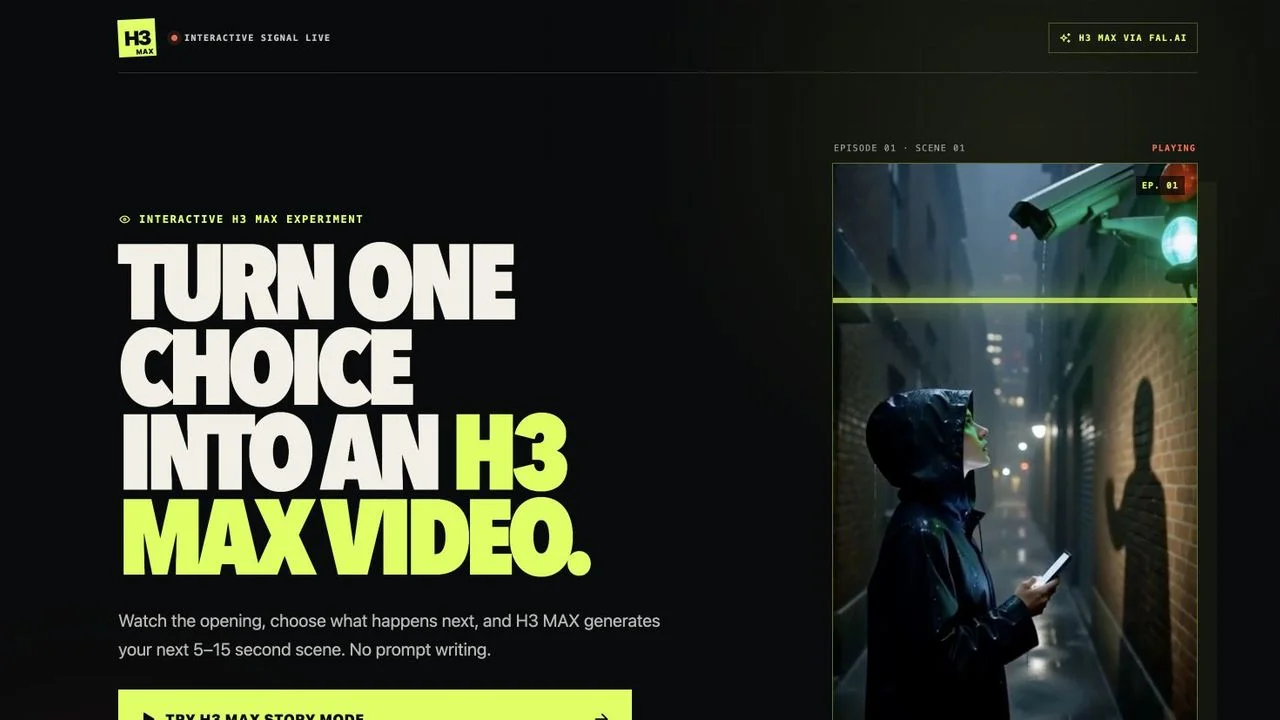
H3 Story Lab is a focused interactive-story prototype rather than a full catalog or game world. Its public page asks for a starting idea, presents choices between scenes, and describes each generated continuation as a five-to-fifteen-second video.
The page identifies H3 Max through fal, while the inspected staging interface names H3 Max Turbo in its generation flow. RetivAI records the more specific visible endpoint label and treats the site as a prototype because it presents itself as a staging build without a public customer checkout.
H3 Story Lab strips interactive video down to an opening, a short generated scene, and a choice about what should happen next. The public page describes continuations in the five-to-fifteen-second range, which creates frequent opportunities to redirect the story without presenting a full game inventory, social layer, or streaming schedule.
The interface associates the experience with H3 Max through fal and displays H3 Max Turbo in the generation flow. RetivAI uses the more specific visible label while classifying the site as a prototype: it is presented as a staging build and does not expose a customer checkout or production operating record. We inspected the form and explanatory states but did not press Generate, spend credits, or evaluate an output clip.
02 / SHORT-SCENE FORMAT
Five-to-fifteen-second clips keep choices close to the action
Short scenes reduce the distance between intent and consequence. A viewer does not have to wait through a long generated sequence before choosing a new direction, and the system receives frequent opportunities to refresh context. This is a practical product pattern for models that can render quickly but still operate as discrete jobs.
The same short horizon limits how much each request must solve. One continuation can focus on a visible action, a reaction, or a reveal instead of inventing an entire episode. Story quality still depends on memory and prompt compilation outside the model, neither of which is documented in enough depth on the staging page to support stronger claims.
Calling the project a lab sets a useful expectation. It can demonstrate the core control loop without claiming durable accounts, saves, public moderation, production billing, or high concurrency. RetivAI preserves that scope rather than padding the page with features that the public build does not show.
- A starting idea establishes the first scene and narrative direction.
- Choices constrain the next request more than an unrestricted prompt box would.
- The page demonstrates the workflow, not a verified production service level.
03 / SCENE-BOUNDARY CONTROL
Each decision starts a new continuation job
The viewer acts between clips. The chosen outcome and current story context become the brief for another short H3 Max Turbo request, and the result creates the next decision point. That is interactive just-in-time generation rather than a continuously steerable Director connection.
A visitor supplies an opening and selects a continuation after each scene, producing one short next segment at a time.
Each choice starts a discrete 5–15 second clip request. Story continuity is created by passing context into the next job, not by maintaining one continuous Director WebRTC session.
- 01
An opening prompt establishes the initial scene and genre direction.
- 02
Short generated clips create frequent points at which a viewer can redirect the story.
- 03
Choice labels constrain the next request so the experience remains closer to interactive fiction than a general prompt box.
- 04
The page routes generation through fal and identifies H3 Max Turbo for the short continuation flow.
04 / STAGING AND TEST COVERAGE
No output claim is made without pressing Generate
RetivAI did not create a story, time a job, inspect audio, or score visual continuity. The private staging build also does not establish persistence, retries, moderation, billing, capacity, or long-term availability. Those are explicit unknowns, not implied capabilities.
- RetivAI did not execute a generation, time the response, or inspect the resulting continuity and audio.
- The public page is a staging build and the implementation is not source available; production readiness is therefore not established.
- The prototype does not expose enough evidence to confirm durable saves, moderation, billing, queue recovery, or long-range story memory.
05 / PUBLIC DEMO RECORD
The staging page supports a narrow but complete prototype profile
The official page supports product identity, fal and H3 Max references, the H3 Max Turbo label, clip-duration range, and choice-driven workflow. It is sufficient for a prototype listing while remaining too narrow for production claims.