01 / LIVE EXPERIENCE
Every generated scene becomes a fork someone can revisit
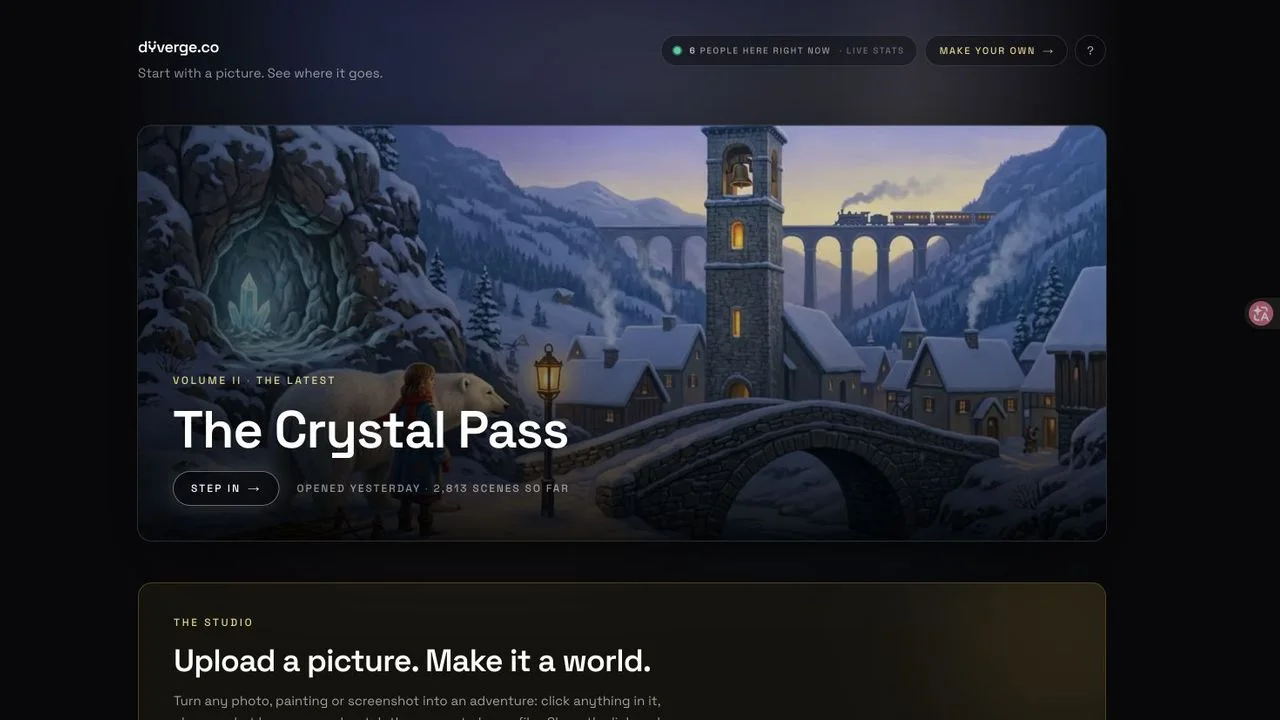
diiverge turns the end of every short scene into a decision point. The player chooses a direction, waits for the next segment to be generated, and leaves behind a saved branch that can be revisited instead of consuming one fixed linear movie.
Creator explanations describe a two-stage continuity handoff: Nano Banana 2 generates the target frame for the chosen outcome, then H3 Max animates from the current first frame toward that target. This corrects an earlier public inference about the pipeline and is recorded as a creator-confirmed implementation claim.
diiverge applies just-in-time video to the grammar of point-and-click adventure games. A scene ends at a decision, the player chooses what should happen, and the next generated segment becomes a new path through the story. Saving that branch changes the value of the output: it is not only a transient response, but part of a growing map that can support replay and comparison.
The most precise public pipeline description comes from the creators. A choice is turned into a target image with Nano Banana 2, and H3 Max then animates from the current visual state toward that target. RetivAI records this correction because an earlier public explanation inferred a different technical path. The creator-confirmed first-to-last handoff is the supported claim; no source repository is available for independent code review.
02 / PERSISTENT BRANCH DESIGN
A saved tree turns generation cost into explorable story state
Linear AI video usually spends compute on a sequence that every viewer receives in the same order. A branching system spends compute only after a choice, then preserves that result as an addressable path. Later players can revisit an existing route or move into a different branch, allowing some generated work to become reusable story inventory rather than a disposable response.
The choice interface also narrows the prompt problem. Instead of asking every player to write a production-ready scene, the product can offer decisions that already fit the current plot and visual world. This improves legibility on mobile and gives moderation a smaller action space, although the private implementation does not reveal how choices are authored or screened.
Visual continuity has a concrete intermediate artifact: the target frame. It describes where the selected action should land before H3 Max produces motion between the current image and that destination. That can stabilize a transition better than asking one text prompt to invent both the destination and the movement, but it cannot guarantee identity, props, geography, or causality across an indefinitely growing tree.
- The next segment is generated after a player decision, not continuously in the background.
- Persistent paths make previous outputs part of the game map.
- The two-stage visual handoff is creator-confirmed and not source-code verified.
03 / CHOICE-TO-TRANSITION LOOP
A selected outcome defines both the next state and its visual destination
The player acts at a scene boundary. The system interprets that branch, prepares a target frame for the intended result, and asks H3 Max to animate into it. When the segment completes, its endpoint becomes the context for the next decision and the path is stored.
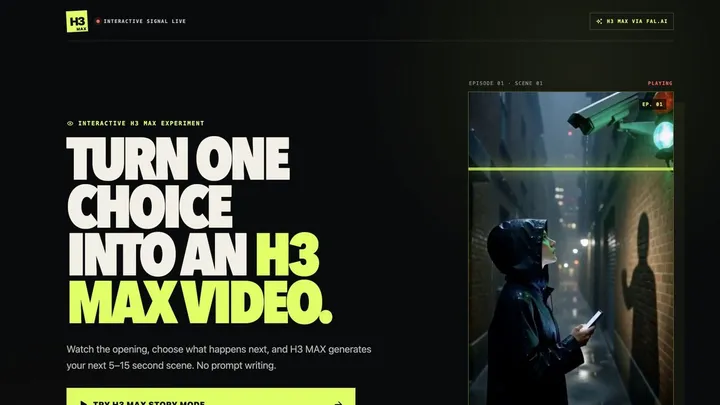
Players select a branch after each scene; that decision becomes the brief for the next generated segment and a new persistent path.
The next H3 Max segment is created after a choice, with an intermediate target frame providing a visual destination. The player experiences a continuing story despite discrete generation jobs.
- 01
The current scene supplies the visual starting point for the next transition.
- 02
A player choice defines the narrative outcome and target state rather than acting as a free-form editing prompt.
- 03
Nano Banana 2 creates the target frame described by the chosen branch.
- 04
H3 Max animates the movement between the current image and the new target, after which the path is saved for later exploration.
04 / CLOSED ORCHESTRATION
The playable result is visible, but the branch engine remains private
The public experience and attributable launch posts establish the product and its model path. They do not expose prompt compilation, content policy, save durability, retry behavior, cost controls, or the exact response time for a new branch. Those remain unresolved rather than inferred.
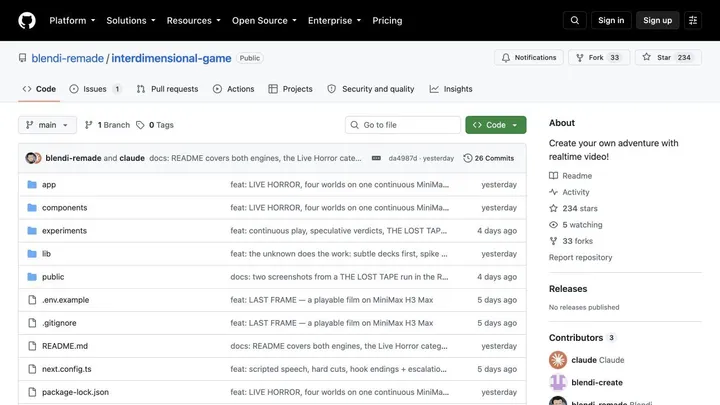
- The orchestration code, moderation rules, persistence model, and provider-spend controls are not public.
- Model and pipeline details rely on attributable creator statements rather than an inspectable source repository.
- A generated branch can preserve visual direction without guaranteeing long-range character, object, or plot consistency across an unlimited tree.
05 / CORRECTED CREATOR ACCOUNT
A later pipeline clarification controls this technical description
The official site supports availability and interaction. The launch statement supports H3 Max and persistent branching. A follow-up creator explanation supports Nano Banana 2 for the target frame and H3 Max for animation, superseding the earlier unsupported inference.