01 / OPEN-SOURCE PROJECT
A small working control room inside a larger broadcast plan
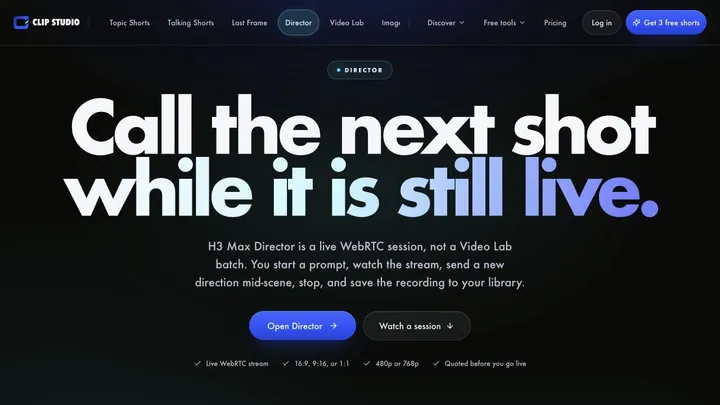
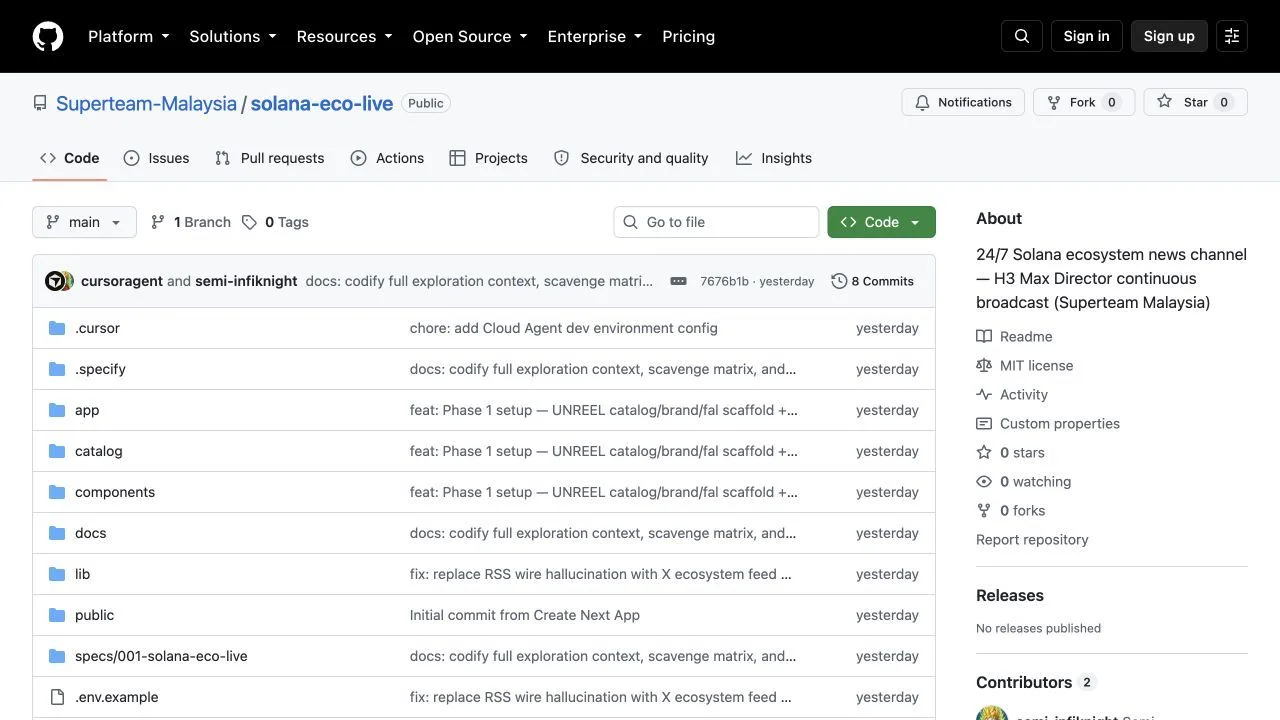
Solana Eco Live proposes a 24/7 ecosystem news channel steered by live social inputs and a showrunner. Its current implementation is deliberately narrower: a user can take air on an H3 Max Director session and send manual prompts.
This distinction matters. It is a real Director integration and a useful control-room reference, but the README labels automated feed ingestion, showrunning, capture, and X broadcast as target architecture rather than completed functionality.
Solana Eco Live imagines a continuous ecosystem channel that can react to social feeds, prepared references, and an automated showrunner. The inspected v0 is intentionally smaller: an operator can open an H3 Max Director session, take air, and send manual prompt updates from a local control surface.
That implemented slice is still useful. It isolates the browser and server responsibilities needed to operate one realtime session and gives later broadcast stages a concrete media source. RetivAI keeps the roadmap visible but labels it separately so a future architecture diagram is not mistaken for a working autonomous news channel.
02 / IMPLEMENTED VS PLANNED
Take air and live prompts exist; autonomous news does not yet
The current path covers the Director connection and manual steering. Feed ingestion, editorial selection, reference preparation, automated showrunning, capture, and social-platform broadcast are described as target stages. Each one introduces separate failure and policy questions that the initial session demo does not solve.
For builders, this honest boundary is valuable. It shows that a 24/7 product should be decomposed into independently testable layers: source selection, editorial planning, generation, monitoring, and distribution. A working model connection is necessary, but it is only one part of a reliable channel.
Manual control is also a sensible first operating mode. It lets a person observe prompt timing, session recovery, and visual drift before automation is allowed to publish from an external feed. Those observations can later become explicit showrunner rules instead of assumptions embedded in a large unattended pipeline.
- Current: local control surface, take-air action, and manual prompt steering.
- Planned: feed-driven showrunner and prepared visual references.
- Planned: capture, ffmpeg processing, and an external RTMP destination.
03 / CURRENT V0 LOOP
An operator steers one persistent Director session
The implemented control surface starts a WebRTC session and sends manual instructions into it. Continuity comes from keeping that session alive, not from generating and concatenating a queue of independent clips.
The current v0 lets an operator start a Director session and send manual prompts from a local control surface.
The implemented core is a live Director WebRTC session. The broader automated 24/7 pipeline is explicitly future architecture.
- 01
Current: take-air control and manual prompt steering.
- 02
Target: social feed and prepared references feed a showrunner.
- 03
Target: capture and ffmpeg convert the Director session into an RTMP broadcast.
04 / ROADMAP BOUNDARY
Do not describe the prototype as an autonomous 24/7 channel
The repository's future stages still require data-source authentication, editorial safeguards, moderation, capture reliability, distribution credentials, and provider spend controls. A fal key and paid output are already required for the implemented core.
- Do not describe the project as an autonomous 24/7 channel today; v0 implements only the Director session and manual prompt stage.
- External-platform broadcasting, moderation, and showrunner behavior require later milestones.
- A provider key and paid generation are required for real output.
05 / MILESTONE RECORD
The source distinguishes current code from target architecture
The repository is the evidence for both the working v0 and the stated future stages. RetivAI reports that boundary verbatim in substance and does not infer completed integrations from the roadmap.